Fisica, nasce SuperB l’acceleratore italiano

Repubblica.it: Fisica, nasce SuperB l’acceleratore italiano.

Pubblicato in News | Lascia un commento

Future aspects of X-ray emission from crystal undulators at channeling of positrons

IL NUOVO CIMENTO – DOI 10.1393/ncc/i2011-10983-9

H. Backe(1)(∗), D. Krambrich(1), W. Lauth(1), B. Buonomo(2), S. B. Dabagov(2)(3), G. Mazzitelli(2), L. Quintieri(2), J. Lundsgaard Hansen(4), U. I. Uggerhøj(4), B. Azadegan(5), A. Dizdar(6) and W. Wagner(7)
(1) Institute of Nuclear Physics, J. Gutenberg-University Mainz – D-55099 Mainz, Germany (2) INFN – Laboratori Nazionali di Frascati – Via E. Fermi 40, F000U Frascati (RM), Italy (3) RAS – P.N. Lebedev Physical Institute – 119991 Moscow, Russia (4) Department of Physics and Astronomy, University of Aarhus

DK-8000 Aarhus C, Denmark (5) Sabzevar Tarbiat Moallem University – Sabzevar, Iran (6) Department of Physics, Istanbul University – Istanbul, Turkey (7) Helmholtz-Zentrum Dresden-Rossendorf – Postfach 51 01 19, D-01314 Dresden, Germany
(ricevuto il 22 Dicembre 2010; pubblicato online il 22 Settembre 2011)

Summary. — In connection with ideas to produce undulator-like radiation in the hundreds of keV up to the MeV region by means of positron and electron channeling, there is renewed interest to study various channeling phenomena also experimentally. With electrons experiments have been performed at the Mainz Microtron MAMI to explore channeling-radiation emission by a 4-period epitaxially grown strained layer Si1−xGex undulator with a period length of λu = 9.9μm. Unfortunately, high-quality positron beams of sufficient intensity are not easily accessible. The only serious candidate in Europe seems to be the Beam Test Facility (BTF) at INFN/LNF, Frascati, Italy. Some requirements to extent BTF in a facility which is also well suited for positron channeling-radiation experiments will be outlined.
PACS 41.60.-m – Radiation by moving charges. PACS 61.85.+p – Channeling phenomena (blocking, energy loss, etc.). PACS 87.56.bd – Accelerators.

Pubblicato in News | Lascia un commento

Siglato oggi l’atto costitutivo del Laboratorio Nicola Cabibbo, il centro internazionale di Fisica promosso dall’ Infn e dall’ Universita’ di Roma Tor Vergata, che portera’ – entro sei anni – alla costruzione dell’acceleratore SuperB nel campus di Roma Tor Vergata.

E’ stato siglato oggi l’atto di nascita del Laboratorio Nicola Cabibbo. Si chiamera’ cosi’ il nuovo centro internazionale di fisica fondamentale e applicata promosso dall’Istituto Nazionale di Fisica Nucleare e dall’Universita’ di Roma Tor Vergata, che hanno formalizzato la costituzione del consorzio per la realizzazione dell’acceleratore SuperB. Si tratta di uno dei piu’ rilevanti tra i 14 progetti bandiera del Piano di Ricerca Nazionale del MIUR ed e’ stato approvato dal documento di programmazione economica del CIPE con un finanziamento di 250 milioni di euro. “I progetti bandiera – ha commentato il presidente dell’Infn Roberto Petronzio – rappresentano una scelta innovativa della politica di finanziamenti pubblici alla ricerca, in linea con analoghe strategie di altri paesi europei per la costituzione di un parco europeo di infrastrutture scientifiche.” Continua a leggere

Pubblicato in News | Lascia un commento

Wikipedia in lingua italiana rischia di non poter più continuare

20111004-204430.jpgCara lettrice, caro lettore,
in queste ore Wikipedia in lingua italiana rischia di non poter più continuare a fornire quel servizio che nel corso degli anni ti è stato utile e che adesso, come al solito, stavi cercando. La pagina che volevi leggere esiste ed è solo nascosta, ma c’è il rischio che fra poco si sia costretti a cancellarla davvero.

Negli ultimi 10 anni, Wikipedia è entrata a far parte delle abitudini di milioni di utenti della Rete in cerca di un sapere neutrale, gratuito e soprattutto libero. Una nuova e immensa enciclopedia multilingue, che può essere consultata in qualunque momento senza spendere nulla. Continua a leggere il comunicato sul sito

Pubblicato in News | 1 commento

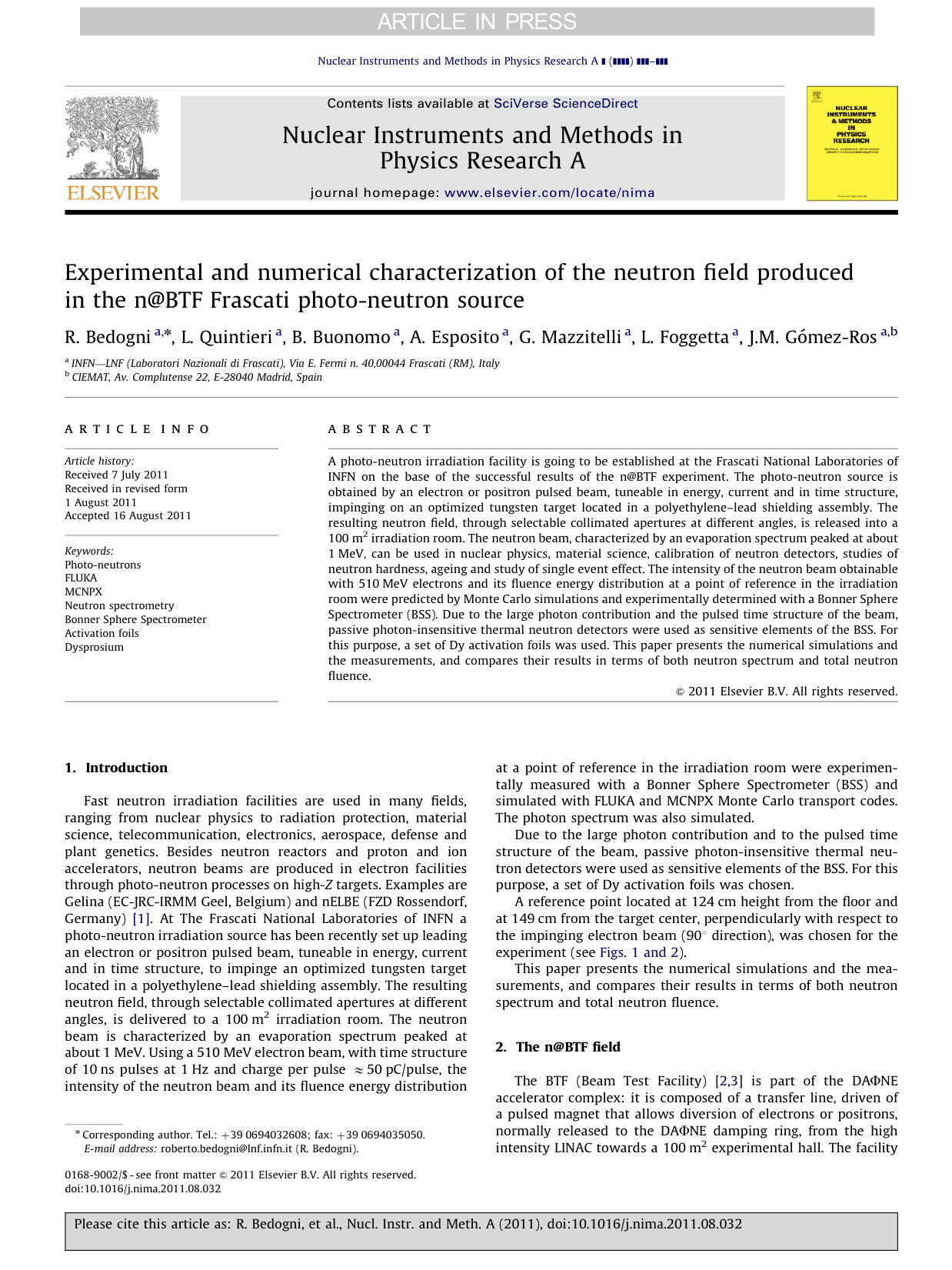
Experimental and numerical characterization of the neutron field produced in the n@BTF Frascati photo-neutron source

R. Bedogni (a,n), L. Quintieri (a), B. Buonomo (a), A. Esposito a, G. Mazzitelli (a), L. Foggetta (a), J.M. Go ́ mez-Ros (a,b)

a) INFN—LNF (Laboratori Nazionali di Frascati), Via E. Fermi n. 40,00044 Frascati (RM), Italy
b) CIEMAT, Av. Complutense 22, E-28040 Madrid, Spain

A photo-neutron irradiation facility is going to be established at the Frascati National Laboratories of INFN on the base of the successful results of the n@BTF experiment. The photo-neutron source is obtained by an electron or positron pulsed beam, tuneable in energy, current and in time structure, impinging on an optimized tungsten target located in a polyethylene–lead shielding assembly. The resulting neutron field, through selectable collimated apertures at different angles, is released into a 100 m2 irradiation room. The neutron beam, characterized by an evaporation spectrum peaked at about 1 MeV, can be used in nuclear physics, material science, calibration of neutron detectors, studies of neutron hardness, ageing and study of single event effect. The intensity of the neutron beam obtainable with 510 MeV electrons and its fluence energy distribution at a point of reference in the irradiation room were predicted by Monte Carlo simulations and experimentally determined with a Bonner Sphere Spectrometer (BSS). Due to the large photon contribution and the pulsed time structure of the beam, passive photon-insensitive thermal neutron detectors were used as sensitive elements of the BSS. For this purpose, a set of Dy activation foils was used. This paper presents the numerical simulations and the measurements, and compares their results in terms of both neutron spectrum and total neutron fluence.

Please cite this article as: R. Bedogni, et al., Nucl. Instr. and Meth. A (2011), doi:10.1016/j.nima.2011.08.032
Pubblicato in News | Lascia un commento